
A clean CCTV finish starts with a route plan, before any cable goes into a wall. The key to hidden security camera wiring inside villa walls is coordinating camera positions, the villa’s structure and the equipment that records and manages footage. Without that plan, cables may remain visible or take a difficult route through finished rooms.
It’s understandable to want security cameras without compromising the look of your interiors. Concealed cabling can create a neater finish, but existing walls, ceilings and finishes may limit the available routes. In some areas, a discreet surface route may be more practical than opening a wall.
This guide covers common concealed and low-visibility wiring methods, how to map routes from each camera to recording and network equipment, and what to consider before work begins. It also explains how CCTV cabling fits into a villa’s home network, so you can plan camera placement, cable routing and connectivity together.
Key Takeaways
- Plan hidden security camera wiring inside villa walls by mapping camera coverage, equipment locations and practical cable routes before installation.
- Compare in-wall routes, existing conduits, ceiling voids and surface conduit to balance appearance, disruption and future access.
- Consider camera placement and recorder location when planning cable paths, so the system remains accessible as well as discreet.
- Match Ethernet cabling to the equipment and installation plan for a dependable connection between cameras, recording equipment and the villa network.
- Coordinate CCTV installation, cable routing and network integration for a tidy, connected security setup in your Dubai villa.
What hidden security camera wiring inside villa walls involves
Concealed CCTV wiring routes the cables connecting cameras to the rest of the system out of everyday view, while keeping them accessible enough to inspect and maintain. It doesn’t mean concealing the cameras themselves. The aim is a clean finish around visible camera units, not covert surveillance. For a general introduction to the system, see Closed-circuit television (CCTV).
With hidden security camera wiring inside villa walls, the route depends on the home’s construction, existing finishes and camera positions. A route that works during a renovation may be disruptive in a finished villa. The installation approach should suit the property rather than follow a single method.
What does concealed CCTV cabling mean in a villa?
Cables can pass through suitable wall routes, ceiling voids or existing conduits before reaching the camera and recording equipment. The best path is discreet without being sealed away without a plan. Accessible connection points and a clear record of the route can make inspection and future maintenance simpler.
Concealing a cable is different from hiding a camera. Cameras remain visible, while their connecting cables are routed out of sight or finished neatly along the building. Plan camera views with household privacy in mind, avoiding private spaces and unintended views into neighboring homes. Include applicable requirements for the property in Dubai in the installation plan.
Which parts of the CCTV system need a cable route?
Each wired IP camera connects by network cabling to the equipment that manages or records its video, such as a network video recorder (NVR) or network switch. The recorder or switch may also connect to the home network, depending on the system design. Mapping these connections shows which routes need to reach each camera and which must continue to the central equipment location.
Power over Ethernet (PoE) carries network data and electrical power to a compatible device over one Ethernet cable. This can reduce the need for a separate power cable at each compatible camera, but both the camera and network equipment must support PoE. Other setups may use a separate power connection. The selected equipment determines the cabling plan.
In a finished villa, existing conduits or ceiling spaces may provide a less disruptive path. In other areas, the wall structure or camera location may call for a different route. Coordinating camera placement, cabling and network equipment helps create a tidy installation without sacrificing access or reliable connections.
How to plan hidden security camera wiring routes before installation
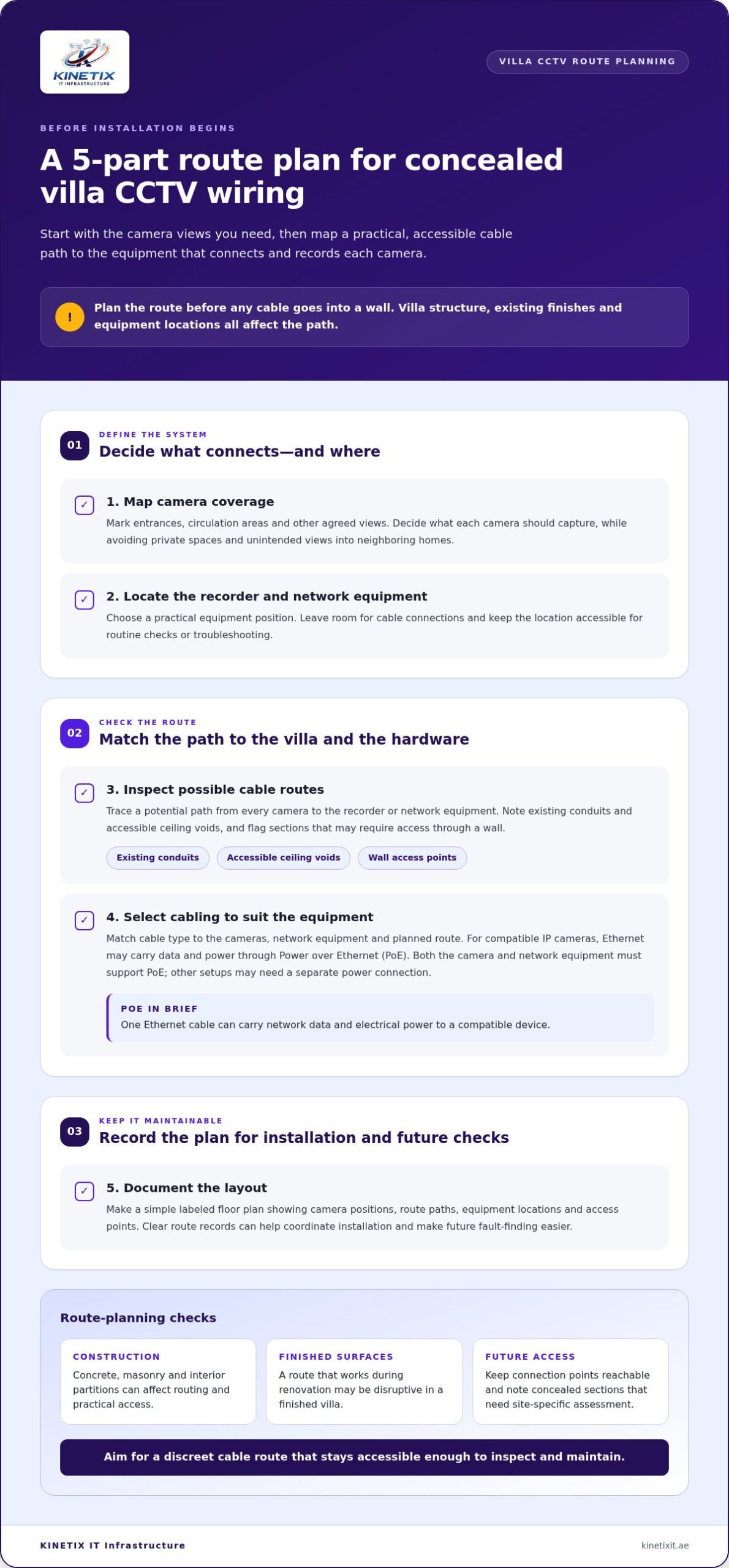
A reliable route plan starts with the views you need, then works backward to the equipment that connects and records each camera. Planning first helps you avoid a cable path that looks convenient on paper but conflicts with the villa’s construction, finished surfaces or maintenance needs. Use this sequence to turn camera locations into a practical cabling plan.
- Map coverage. Mark entrances, circulation areas and other agreed views for camera coverage. Decide what each camera should capture, while avoiding views into private spaces or neighboring properties.
- Locate the equipment. Choose a practical position for the recorder and any network equipment. Leave room for cable connections and access for routine checks or troubleshooting.
- Inspect possible routes. Trace potential paths from every camera to the recorder or network equipment. Note existing conduits and accessible ceiling voids, and identify sections that may require access through a wall.
- Select the cabling. Match the cable type to the camera, network equipment and planned route. For compatible IP cameras, Ethernet may carry data and power through PoE. Other configurations may need a separate power connection.
- Document the plan. Record camera positions, route paths, equipment locations and access points. A simple labeled floor plan can make installation coordination and future fault-finding easier.
How should you map camera and recorder locations?
Start with the villa’s entry points and the areas you want covered. Mark each proposed camera position and its intended field of view, then place the recorder and network equipment where connections can be organised and reached for maintenance. Review each view for privacy before settling the layout. Once the positions are clear, draw cable paths between the cameras and equipment.
How do villa wall and ceiling conditions affect the route?
Existing conduits and accessible ceiling voids may provide useful paths, while a route through a finished wall may require a different approach. Don’t assume all walls have the same construction. Concrete, masonry and interior partitions can affect how cabling is routed and what access is practical. Mark planned routes and access points, especially where concealed sections need a site-specific assessment.
This preparation is especially useful for hidden security camera wiring inside villa walls, where the neatest route depends on the actual structure and finishes. A coordinated CCTV and network cabling plan connects camera locations to recording equipment while keeping future access in view. Explore coordinated villa CCTV and cabling as part of planning a connected installation.
Concealed cabling versus surface conduit: which option suits your villa?
The neatest-looking route isn’t automatically the best one. A cable hidden in a wall may be difficult to access later, while carefully placed surface conduit keeps wiring organised and reachable. The right choice depends on the villa’s construction, existing pathways, finished surfaces and the balance you want between appearance and maintenance access.
| Routing method | Appearance | Disruption and access | Often suits |
|---|---|---|---|
| In-wall routing | Most discreet once finished | May require wall access; concealed sections can be harder to inspect | Renovations or planned work before finishes are complete |
| Existing conduit | Discreet if the pathway is concealed | Can avoid creating a new route, but access and capacity need assessment | Villas with a suitable, usable pathway |
| Ceiling void | Usually out of sight | Access depends on the ceiling design and available inspection points | Routes between cameras and equipment across accessible ceiling spaces |
| Surface conduit | Visible, but can be aligned neatly with the room | Generally remains accessible for inspection or changes | Finished spaces where opening walls is undesirable or impractical |
When is in-wall CCTV wiring a suitable choice?
In-wall routing can suit a renovation or new installation planned before interior finishes are complete, when cable paths can be coordinated with other work. In an already finished villa, feasibility depends on the wall construction and how the route can be accessed. Don’t cut into an unknown wall or interfere with structural elements just to hide a cable. Assess the specific route first.
When can conduit or ceiling routes be more practical?
An existing conduit or accessible ceiling void may provide a route without opening a finished wall, though its suitability still needs assessment. Surface conduit is another option: it keeps cabling contained and organised, but remains visible. Consider whether connections will be reachable for future inspection or repair. Appearance matters, but so does access.
For hidden security camera wiring inside villa walls, a mixed approach can work well. A route might use an existing ceiling pathway for one section and a short, discreet conduit where wall access would be unsuitable. Assess each section on its own merits. A coordinated CCTV and network cabling plan can balance a refined finish with practical access across the villa.
How to prepare for a tidy, reliable villa CCTV wiring installation
Preparation helps camera positions, cable routes and network equipment work as one system. Before installation, settle the decisions that affect the finished result and note areas where access or appearance needs special attention.
What should you decide before the installation begins?
- Confirm camera positions and views. Mark the intended coverage for each camera, including entrances and circulation areas. Make sure the views suit your household’s privacy needs.
- Choose the recorder location. Identify where the recording equipment and any network switch will sit, with practical access for connections and maintenance.
- Mark likely cable paths. Note existing conduits and accessible ceiling spaces, along with finished or occupied areas that need careful coordination during work.
- List current network equipment. Record the location of the router, switches and existing network cabling. This helps coordinate CCTV runs with villa network cabling and can avoid unnecessary duplicate routes.
Choose Ethernet cable that suits the requirements of the cameras and network equipment, as well as the planned route. The right option depends on the system, so don’t select cable based only on a label or assume one type suits every camera. A coordinated plan connects each camera to its recording equipment and integrates the system with the residential network where required.
What should a finished installation be checked for?
Test the complete connection, not just whether a camera powers on. Confirm that each camera feed reaches the recording system, displays as intended and records correctly with the installed equipment. Review playback and relevant recording settings, and check network integration or remote viewing if those features are part of the setup.
Before the work is considered complete, make sure cable routes and access points are documented. This record can help with future troubleshooting by showing where concealed cabling runs. It’s also useful to confirm that connections are organised and accessible wherever the installation plan allows.
For hidden security camera wiring inside villa walls, preparation helps align a discreet finish with dependable connections and future support. KINETIX IT Infrastructure coordinates CCTV installation with network cabling for villas in Dubai. Plan your villa CCTV and network cabling as one connected installation.
Get hidden security camera wiring integrated across your Dubai villa
A clean, dependable CCTV installation treats camera coverage, cabling and network connections as parts of the same plan. Each camera needs a useful view, a suitable route to recording equipment and reliable connectivity within the home. Planning these elements together helps avoid routes that look discreet but leave connections difficult to reach or the system awkward to maintain.
How does integrated CCTV installation support a cleaner result?
Plan camera positions and cable routes together. For example, a camera aimed at an entrance needs a practical path back to the recorder or network equipment, whether that route uses an existing conduit, a ceiling space or another suitable pathway. Coordinating CCTV installation with villa network cabling helps organise these connections as one system rather than a set of separate runs.
Network integration connects cameras with recording equipment and, where the system is designed for it, the residential network. The installation should balance a considered finish with dependable operation and practical access for future support. Concealed cabling doesn’t have to mean inaccessible cabling: recording the route and connection points helps with inspection and troubleshooting.
For Dubai villa owners planning hidden security camera wiring inside villa walls, the route must suit the property’s construction and finishes. KINETIX IT Infrastructure brings CCTV installation and network cabling together to plan a coordinated villa setup around camera coverage and connectivity.
What is the next step for planning your villa installation?
Start with a simple outline of the views you want, likely camera positions and possible locations for recording or network equipment. Note existing network equipment, visible finishes and any areas where access may be limited. These details help shape a route plan around the villa rather than forcing the property to fit a generic layout.
For a broader overview of the installation process, read the professional CCTV camera installation guide and structured cabling guide alongside this article. Together, they can help you consider camera selection, system connections and cable planning before work begins.
If you’re ready to plan a coordinated setup, Discuss your villa CCTV installation with KINETIX IT Infrastructure.
Plan a cleaner, more connected villa CCTV system
A tidy installation starts with a route plan. Match camera positions to the views you need, then choose cabling paths that suit your villa’s construction and keep future access in mind. In-wall wiring can create a discreet finish, while existing conduits, ceiling spaces or surface conduit may be more practical in particular areas.
For hidden security camera wiring inside villa walls, dependable results come from coordinating camera coverage, recording equipment and network connections as one system. KINETIX IT Infrastructure provides residential CCTV camera installation and network integration, alongside villa network cabling and Ethernet installation. CCTV troubleshooting, repair and ongoing support can also help keep the system working over time.
Share your coverage goals and preferred equipment locations to begin planning an installation tailored to your villa. Plan your villa CCTV installation with KINETIX IT Infrastructure, and take the next step toward a considered, connected home security setup.
Frequently Asked Questions
Can security camera wiring be hidden inside existing villa walls?
Yes, camera wiring can sometimes be routed out of sight through existing wall pathways or conduits. Whether that works depends on the villa’s construction, available access and existing finishes. A ceiling void may provide a practical route between rooms, while other sections may need a different approach. Assess the actual path before work begins, and don’t cut into an unknown wall simply to conceal a cable.
How do you run CCTV cables through a villa without opening every wall?
Use a combination of suitable routes rather than assuming every cable must pass inside a wall. Existing conduits and accessible ceiling spaces can connect camera positions to a recorder or network equipment with less disruption. Where those paths aren’t suitable, a short, neatly placed surface conduit may complete the route. Mapping each camera connection first helps keep cabling organised and limits unnecessary wall access.
Is PoE a good option for wired security cameras in a villa?
PoE can be a practical option for compatible wired IP cameras. Power over Ethernet carries data and electrical power over one Ethernet cable, which can simplify the connection at each camera. The camera and network equipment must both support PoE, and the installation needs to suit the equipment’s power requirements. A network switch or recorder with PoE can connect compatible cameras to the recording system.
Can CCTV cables be hidden behind concrete or masonry walls?
Sometimes, but concrete and masonry can make concealed routing more involved than using an accessible conduit or ceiling space. The workable method depends on the wall, the route and available access. Don’t assume a wall can be cut safely or that a cable can pass through it without affecting structural elements. Consider existing pathways or discreet conduit where opening the wall isn’t suitable.
Is conduit better than concealed CCTV wiring?
Neither option is best for every villa. In-wall wiring offers a more discreet finish, but concealed sections can be harder to inspect and may require wall access. Conduit keeps cables contained and easier to reach, though it remains visible. Existing conduits and ceiling voids may offer another balance. Compare appearance, disruption and future maintenance access for each part of the route.
How do hidden CCTV cables connect to the recorder and home network?
For a wired IP system, Ethernet cables connect cameras to compatible network equipment, such as a PoE switch or recorder. The recorder manages the camera feeds, while a connection to the home network can support network integration where the system is designed for it. The exact layout depends on the equipment. Plan routes from each camera position to the recording and network equipment location.
Can existing villa network cabling also support CCTV cameras?
It may, if the existing Ethernet cabling and network equipment suit the cameras and planned system. Check where each cable runs, what equipment it connects to and whether the setup supports the intended camera connections, including PoE if required. Don’t assume that a nearby network socket is a direct camera connection. In Dubai, KINETIX coordinates residential CCTV installation with villa network cabling and integration.