
What if the Wi-Fi problem isn’t your internet connection, but the path the signal has to travel? A wireless site survey Dubai homeowners can use to understand coverage considers how a property’s layout, walls, interference and access-point positions affect service. The findings can turn frustrating dropouts between rooms or floors into practical network decisions.
Slow or inconsistent Wi-Fi doesn’t always mean the router or internet service is at fault. The cause could be limited coverage, a poorly placed access point, network configuration or a particular device. Distinguishing between these possibilities helps you choose a targeted fix instead of making changes by guesswork.
This guide explains what predictive, passive and active surveys can reveal, how to interpret their findings, and how to plan Wi-Fi around your property’s layout and daily use. You’ll also learn when access-point placement, router configuration or network cabling may help improve coverage. KINETIX IT Infrastructure provides Wi-Fi troubleshooting, optimization, access-point installation and coverage improvement for homes and villas in Dubai, helping turn network needs into practical setup decisions.
Key Takeaways
- A wireless site survey dubai property owners can use helps clarify whether Wi-Fi trouble may stem from coverage, interference, congestion, internet service or device limitations.
- Signal strength and signal quality provide different clues when assessing Wi-Fi performance.
- Predictive, passive and active surveys each offer different information for network planning.
- Mapping rooms, floors, devices and everyday activities makes coverage needs clearer before planning changes.
- Access-point placement, router configuration and cabling can each support practical Wi-Fi coverage improvements.
What a Wireless Site Survey in Dubai Reveals About Your Wi-Fi
A wireless site survey is a structured assessment of Wi-Fi signal, coverage needs and network conditions across a property. It helps show where connections weaken, what may be affecting performance and which network changes could better support everyday use. For a wireless site survey Dubai homeowners can use to plan improvements, the important step is relating technical observations to the rooms and activities that matter.
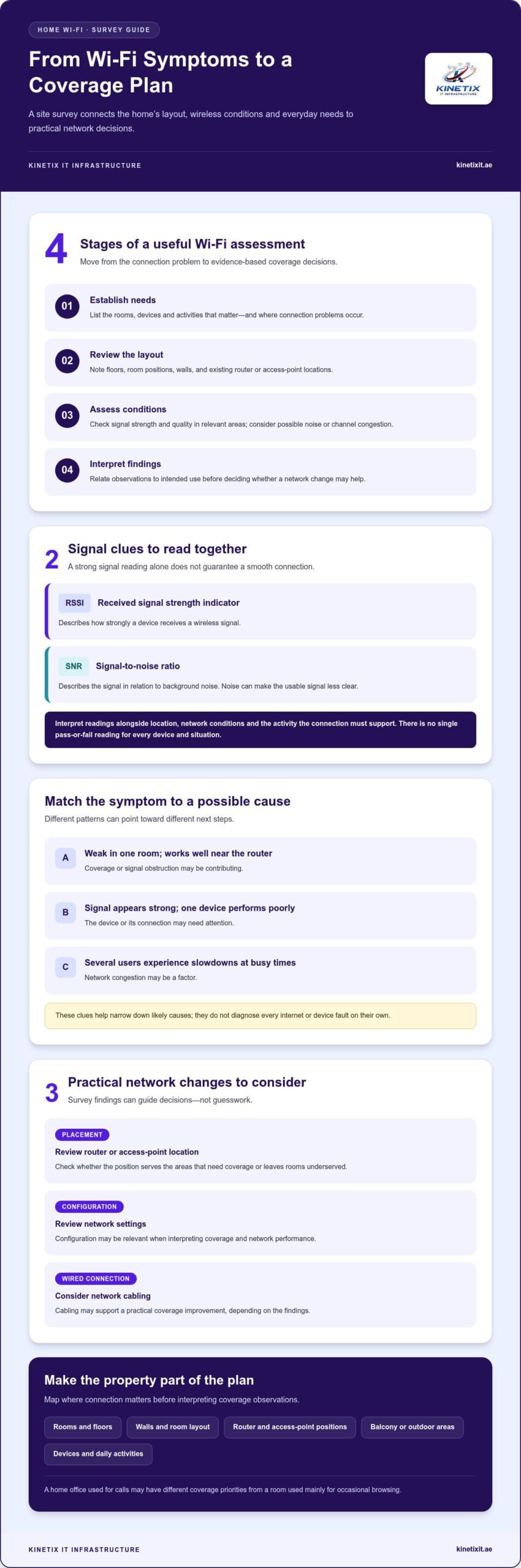
A survey doesn’t automatically mean the internet service itself is at fault. If Wi-Fi is weak in one room but works well near the router, coverage or signal obstruction may be contributing. If the signal appears strong but a particular device performs poorly, the device or its connection may need attention. Slowdowns affecting several users at busy times can also point to network congestion. These causes call for different next steps, so identifying where and when the problem occurs is useful.
A Wireless site survey can use different assessment approaches. Its value at home is straightforward: use evidence about the property and network to make better-informed coverage decisions. Findings can guide Wi-Fi troubleshooting, optimization, access-point placement or cabling, rather than relying on guesswork.
What questions can a Wi-Fi survey answer?
A useful assessment connects signal conditions to the way people use the home. It can help identify where coverage becomes weak or inconsistent and whether router or access-point placement, network configuration or surrounding interference may contribute. It can also clarify which areas need reliable service for activities such as video calls, streaming and connecting household devices.
- Where does Wi-Fi struggle? A room-by-room view can distinguish an isolated dead zone from a broader coverage issue.
- What might be contributing? Observations can help separate a placement or configuration concern from device-specific trouble or congestion.
- Which spaces need dependable service? A home office used for calls may have different priorities from a room mainly used for occasional browsing.
These clues don’t diagnose every internet or device fault on their own. They help narrow down likely causes and indicate whether the next step is to review the home network, test a device or investigate the internet connection.
Why property layout matters in Dubai homes
Wi-Fi has to travel through the actual structure of a home. In a multi-floor Dubai villa, a router on one level may not provide consistent service upstairs. Walls and the arrangement of rooms can also affect how well the signal reaches bedrooms, living areas and home offices. A plan based only on the property’s overall size may miss the specific places where people need a reliable connection.
Before assessing coverage, note where service matters and what happens there. Include frequently used rooms, the floors they’re on, and any balcony or other outdoor area where you expect to connect. Record the devices and activities involved, such as calls in a home office or streaming in a family room. This practical map helps turn observations into decisions about coverage improvement, router configuration, access points or network cabling.
How Wireless Site Surveys Assess Coverage, Signal, and Interference
A useful assessment follows a clear sequence: define how the home needs to connect, review the property layout, assess wireless conditions, then interpret what the observations mean for coverage. This keeps the focus on real use rather than readings in isolation. For a wireless site survey Dubai homeowners use to plan improvements, a bedroom video call, a living-room streaming device and connected equipment elsewhere in the home may each raise different coverage considerations.
- Establish needs. Identify the rooms, devices and activities that matter, including where connection problems occur.
- Review the layout. Note floors, room positions, walls and existing router or access-point locations.
- Assess conditions. Examine signal strength and quality in relevant areas, considering possible noise or channel congestion.
- Interpret findings. Relate observations to intended use before deciding whether placement, configuration or another network change may help.
Interference and channel congestion are possible contributors, not automatic explanations for every slow connection. Nearby wireless activity or physical barriers may affect performance, but an assessment needs to show whether those factors are relevant in the spaces being considered.
What do signal strength and signal quality mean?
RSSI, or received signal strength indicator, describes how strongly a device receives a wireless signal. SNR, or signal-to-noise ratio, describes the signal in relation to background noise. A strong reading alone doesn’t guarantee a smooth connection: noise can make the usable signal less clear. Signal readings need to be interpreted in context, alongside location, network conditions and the activity a connection must support. There isn’t one pass-or-fail reading that applies to every device and situation.
How assessment findings guide access-point placement
Findings can help show whether an access point is positioned to serve the areas that need coverage or whether its location may leave rooms underserved. For example, observations across a home office and an adjacent living area can inform placement based on the spaces in use, rather than relying on the router’s location alone. The right plan depends on the property layout and coverage priorities.
After a placement or configuration change, follow-up checks in the intended areas can help assess whether conditions have improved and whether weak spots remain. This ties the decision to the original need. For more planning context, the Dubai villa Wi-Fi installation guide explores considerations for setting up a connected home.
When findings point to a practical network change, KINETIX can help connect coverage goals to Wi-Fi optimization, access-point installation, router configuration or network cabling. Explore home Wi-Fi setup and coverage support as a next step toward a network planned around your property.
Predictive, Passive, or Active Survey: Which Approach Fits Your Site?
The right approach depends on whether you’re planning Wi-Fi for a property, checking an installed network or investigating a specific problem. A predictive survey supports early planning. Passive and active surveys gather information on-site but examine different aspects of wireless performance. For a wireless site survey dubai project, matching the method to the decision helps keep the assessment relevant to the home.
| Approach | Purpose and typical inputs | Useful decisions |
|---|---|---|
| Predictive | Models expected coverage using a floor plan and assumptions about the building and network. | Inform early access-point planning before equipment is installed. |
| Passive | Observes wireless signals on-site without relying on a user data test. | Reveal where signals are present, weaker or potentially affected by other wireless activity. |
| Active | Uses a connected test device to assess network performance. | Help investigate how the existing connection performs in areas of concern. |
These methods answer different questions rather than competing to be the single best choice. Let the property’s stage and the issue you’re trying to understand guide the selection.
When is predictive Wi-Fi planning useful?
A floor plan can help anticipate how access points might serve rooms and floors before installation. This makes predictive planning useful for a new setup or a planned network change. The result depends on the accuracy of the layout and assumptions about building materials and network conditions. Treat it as a planning aid, not proof of how Wi-Fi will behave in the completed home.
For example, a plan can help identify possible access-point locations for the areas a household expects to use. But actual walls, furnishings, equipment placement and surrounding wireless conditions can differ from assumptions. If the network is already installed and a room has inconsistent service, on-site observations can add evidence that a floor plan alone can’t provide.
When do passive and active surveys help?
A passive assessment observes signals available in the environment. It can help show where a network signal reaches and where wireless conditions differ across the property, without testing data transfer through a connected device. An active assessment connects a test device to the network and measures performance, offering a closer look at how the connection behaves in the areas being checked.
That distinction matters during troubleshooting. If a room receives a signal but an activity still performs poorly, an active check may help examine network performance there. If the concern is where signals weaken or overlap, passive observations may be more informative. Neither method is an automatic diagnosis. Findings need to be considered alongside the home’s layout, devices and intended use.
In practice, use predictive planning when the network is still being designed, and consider on-site assessment when checking an installed setup or investigating a coverage concern. Findings can inform practical next steps, such as Wi-Fi optimization, router configuration, access-point installation or cabling. KINETIX provides these residential network services in Dubai, connecting coverage needs to suitable home Wi-Fi improvements.
Plan a Dubai Wireless Site Survey Around Your Property and Daily Use
A useful assessment starts with a clear picture of how your household uses each part of the home. In a Dubai villa, a connection that works well in the living room may not meet the needs of an upstairs office or a balcony used for calls. Before a wireless site survey dubai assessment, record where you need dependable Wi-Fi and what happens when it falls short. This gives the findings practical context.
What information should homeowners prepare?
Keep the preparation simple. A floor plan can help, but a written room-by-room list is useful too. Note the router’s current location and any existing access points, then mark where problems occur. Include when they’re most noticeable: a connection that struggles during busy evening use may call for a different investigation from a signal that is consistently weak in one room.
- Map the spaces: List the floors and rooms that need reliable Wi-Fi, including bedrooms, living areas, home offices and any balcony or other outdoor-use area.
- Record the devices: Note the devices used in each space, such as work computers, televisions and connected household equipment.
- Describe the activity: Distinguish video calls, streaming and general browsing. These use patterns help clarify which areas need particular attention.
- Mark the trouble spots: Record where connections drop or feel inconsistent, and when those issues tend to appear.
In multi-floor homes, identify the affected level as well as the room. Note substantial walls or areas where the layout separates rooms from the router. This helps relate observations to the structure instead of treating the property as one open space.
How should findings become a practical improvement plan?
Use the findings to prioritize. Start with spaces where connection matters most, such as a home office used for calls or a family area used for streaming. Then compare possible responses: adjusting router placement, adding an access point to serve a specific area, or using a wired connection for a device or location where it makes sense. Each option addresses a different network need, so the plan should reflect what the assessment reveals.
A wired connection may suit a stationary device or help connect network equipment, while Wi-Fi access points can extend wireless coverage to intended areas. Structured cabling can also form part of a broader network design. A placement or configuration change may improve conditions in a target space, but it won’t necessarily address every cause of poor performance. Follow-up checks can show whether the intended area benefits and whether another issue remains.
For a home or villa in Dubai, KINETIX can connect coverage findings to Wi-Fi optimization, access-point installation, router configuration and network cabling. Plan your home Wi-Fi improvements with KINETIX around the rooms and activities that matter to your household.
How KINETIX Connects Survey Findings to Better Wi-Fi in Dubai
Survey findings are most useful when they lead to practical choices for the home. If an assessment shows that a particular floor or room needs stronger coverage, the next step may involve reviewing router configuration, considering access-point placement or exploring a wired connection for suitable devices. KINETIX IT Infrastructure helps Dubai homeowners and villa residents connect those needs to Wi-Fi setup, troubleshooting and coverage improvement.
The aim isn’t to add equipment without a clear reason. It’s to shape a network around the property and the way people use it. A home office, living room and upstairs bedroom may have different connectivity priorities, so improvements should reflect the areas and activities identified.
From coverage needs to Wi-Fi setup
Network configuration and access-point placement can be considered together. A router adjustment may suit one issue, while an access point may be relevant when coverage needs to reach a separate area. Where a wired connection is appropriate, network cabling can support the wider home setup. KINETIX also provides Wi-Fi troubleshooting and optimization for residential connectivity concerns. Explore expert Wi-Fi technician solutions in Dubai for related home networking support.
These options respond to different findings. A device that struggles in one room may call for a focused check of that area, while inconsistent service across multiple spaces could make broader coverage planning relevant. The appropriate choice depends on the network and property. Tie each proposed change to the issue it is intended to address, rather than treating it as a universal fix.
What to expect when discussing your network
A clear starting point is a short description of the property and the connection issues you’ve noticed. Share the floor layout, current router and access-point locations, weak-signal areas, and the rooms where dependable Wi-Fi matters most. Include everyday priorities such as video calls, streaming or connecting household devices. These details help focus the discussion on your actual needs.
Practical setup and optimization choices can then be considered in context. Depending on the home and the concern, the discussion may focus on router configuration, Wi-Fi coverage improvement, access-point installation or network cabling. A tailored approach keeps decisions connected to the spaces you want to use, without assuming one adjustment will resolve every possible cause of poor performance.
If you’re exploring a wireless site survey dubai homeowners can use to inform network changes, its findings can provide a useful basis for choosing next steps. KINETIX supports residential Wi-Fi installation, troubleshooting, dead-zone fixing and optimization across Dubai, with related network configuration and cabling services.
Ready to discuss your home’s coverage priorities? Discuss your Dubai Wi-Fi requirements with KINETIX and outline the spaces and everyday connections you want your network to support.
Make Your Next Wi-Fi Decision with Confidence
Connectivity needs can shift as rooms take on new purposes, household routines change or additional devices become part of daily life. Treat Wi-Fi planning as a considered decision, not simply a hardware purchase. A wireless site survey dubai homeowners can use as a planning reference keeps attention on the property’s real requirements, both now and as those needs evolve.
Before making changes, decide what a better connection would mean for your household. Is the priority smoother work calls, more consistent service in a frequently used space, or a network that can adapt to new routines? Clear goals give any next steps a purpose and make it easier to assess whether a proposed change is relevant.
It can also help to revisit those priorities when your household’s use of the home changes. A setup that suited one routine may need adjustment as rooms or devices take on different roles. Keeping the goal clear helps guide future network decisions without relying on guesswork.
Discuss your Dubai Wi-Fi requirements with KINETIX and take a considered next step toward connectivity that fits your home. A well-planned network can make everyday life feel more seamless.
Frequently Asked Questions
Is a wireless site survey worth it for a Dubai villa?
It can be worthwhile if Wi-Fi performance varies noticeably between floors or in rooms used for work, study or entertainment. A survey can help make network decisions specific to the villa, rather than adding equipment based on a guess. It may be especially useful before a renovation or network change, when you want to plan around the property’s layout and household priorities.
Can a wireless site survey identify why my Wi-Fi is slow?
It can help narrow down likely causes, but it may not explain every type of slowdown on its own. For example, if one device struggles while others work normally in the same room, the device may be part of the issue. If several devices slow down together, the network or internet connection may need further investigation. Note which devices are affected and when.
How much does a wireless site survey cost in Dubai?
There isn’t one fixed cost that applies to every Dubai property. The scope can depend on the home’s size and layout, the type of assessment, whether the network is being planned or investigated, and what information is needed to guide decisions. A villa with several floors and an existing coverage concern may require a different assessment scope from an early planning exercise.
What happens during a wireless site survey?
A survey begins with the property’s connectivity needs and relevant layout information. Depending on the approach, the assessment may model expected coverage from a floor plan or examine wireless conditions on-site. An active check can use a connected device to assess network performance. The aim is to relate observations to the areas and activities under consideration, not simply collect technical readings without context.
Do I need a wireless survey before installing Wi-Fi access points?
No, a survey isn’t always essential before installing access points, but an assessment can help inform placement. It’s useful if you’re unsure which rooms need additional coverage or if a previous placement hasn’t addressed the problem. For a straightforward setup, network planning can use the property layout and intended use to guide installation. The choice depends on the decision you need to make.
How is a wireless site survey different from an internet speed test?
An internet speed test checks connection performance at a particular device and moment. A wireless site survey looks more broadly at Wi-Fi conditions across relevant parts of the home. For a useful comparison, note where the test was run, whether the device used Wi-Fi or a wired connection, and whether other devices were active. That context can help distinguish local wireless trouble from broader connection slowdowns.
Should I prepare my home before a Wi-Fi survey?
Yes, a little preparation can make the assessment more focused. Write down the rooms where problems occur, the devices affected and what you were doing when the issue appeared. Note the router’s location and any access points already in use. If a problem happens at a particular time, include that detail too. You don’t need to move furniture or rearrange rooms before discussing your network.